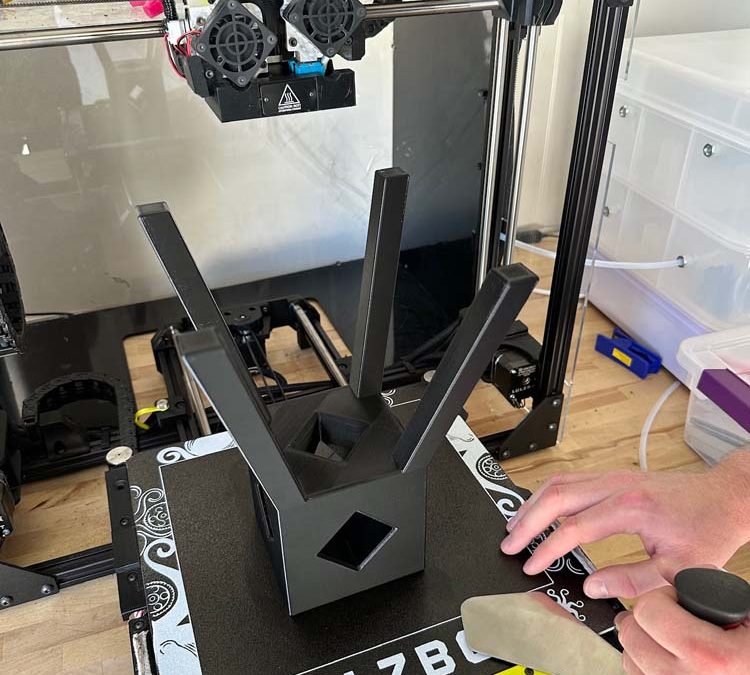
After living and working in the technology world, I occasionally forget that not everyone is familiar with 3D printing. This powerful tool can produce rigid and flexible plastic parts with amazing detail and functionality. As prices have dropped and quality has improved, the community has grown dramatically. However, when I began exploring how I might dip my toe in, I found absolutely no examples of other blind people designing and producing 3D printed projects. This post is just a quick overview on how I got started. Future posts will provide more in depth information.
How It Works
There are two primary printing technologies at the consumer level: Stereolithography (SLA) and Fused Deposition Modeling (FDM). SLA uses liquid resins that can be quite toxic and damaging to skin if touched. For this, and other reasons, I am focused on FDM printing for the time being.
FDM printing uses spools of thin filament made out of a wide range of materials. This filament is heated to high temperatures of 180C and above so that it softens enough to be pushed through a narrow nozzle. The printing is performed one layer at a time by extruding many of these fine filament strands onto a flat build plate. The breadth of filament material is quite amazing. Standard ABS, high strength polycarbonate, and even plastics with finishes like copper and stainless steel, are just some of the options.
Choosing A Printer
The market for FDM printers has grown enormously. A quick search online will find countless reviews on printers ranging from hundreds to thousands of dollars. High end printers often produce more accurate parts, have larger build areas, and multiple extruders for printing more than one material at a time. While the low cost of some printers is extremely attractive, these typically require more work to setup and may operate far less reliably. Do your research and spend enough to get a printer that will meet your needs.
In order to give a concrete recommendation, the Lulzbot Mini 2 is a well built printer. It is more expensive than others at $1,500, but I have found it to be accurate and reliable. The Lulzbot printers come ready for printing and are accompanied by all of the necessary tools. In addition, my experience has shown their customer support to be quite responsive which is very helpful when just getting started.
Time for Design
Now for the big question: how does a blind person design models for 3D printing? Sighted designers have many options for CAD (Computer Aided Design) software today. They are able to effectively draw the 3D shape. As always, people tend to believe 3D modeling must be done visually just because that is how it tends to be done. Wrong! 3D models are simply a description of a shape. Computers store this description and then display it visually to the designer. All a blind maker needs is a method of describing what they are already imagining in their mind.
Much to my surprise, a solution exists. The OpenSCAD software package defines a textual language for model definition. As it turns out, even some sighted designers prefer this approach. It may not seem obvious at first, but most designs can be described by combining simple shapes like squares, circles, cubes, and spheres in various ways. The OpenSCAD language makes it simple to merge, cut, and move these simple pieces into place. Of course, it takes practice to visualize the desired part and break it down into smaller components that can be described in this manner. Once mastered, however, the sky is the limit. My own designs have become far more complicated and refined in a short amount of time.
A Few Notes
Here are a few quick tips and links to additional resources.
- The extruder is hot! Blind people are inclined to touch things. Keeping the nozzle clean is important but please take care when doing it.
- If using a printer with the same extruder as the Lulzbot mentioned above, this nozzle sock is a lifesaver for keeping filament from sticking to the extruder when a print fails.
- With my extensive programming background I have found that I prefer using the Python programming language and the solidpython package to generate OpenSCAD code. Python is more flexible and makes it much easier to create reusable code across designs.
Conclusion
This post is just a starting point. I will be working on numerous deep dives into particular techniques, tools, and lessons learned. All 3D printing enthusiasts are well aware of the work that goes into becoming proficient in the endeavor. With some trial and error I am completely confident that blind individuals can leverage this incredible technology to accomplish just about anything. Nothing compares to independently making a vision into something real.